
'/%3e%3cdefs%3e%3clinearGradient%20id='prefix__paint0_linear_4737_37157'%20x1='3.018'%20y1='23.6'%20x2='44.925'%20y2='24.977'%20gradientUnits='userSpaceOnUse'%3e%3cstop%20stop-color='%231CB7FF'/%3e%3cstop%20offset='.502'%20stop-color='%232FF58B'/%3e%3c/linearGradient%3e%3c/defs%3e%3c/svg%3e)

Behind the scenes at the Gtech: Daily Mail Sport gets unprecedented access for what dealing with a Premier League matchday is REALLY like - from 2,3000 venison pies to a private sommelier for Thomas Frank!
Jan 07 2026 15:16 · By Riath Al-samarrai · 28 Reads


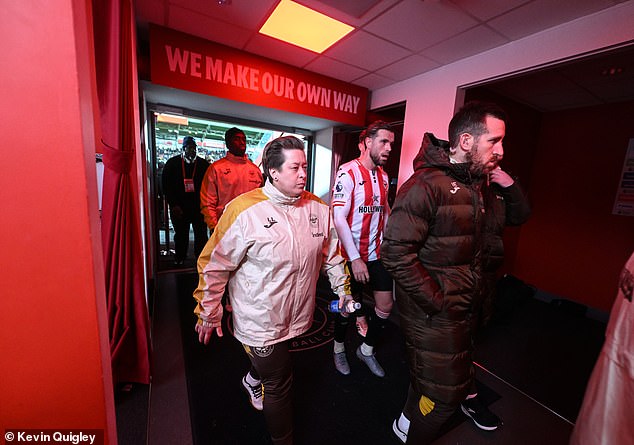
It's a little past 7pm, New Year’s Day, and kick-off is an hour away at Brentford ’s Gtech Community Stadium. Lights inside the busy tunnel have been dimmed to a moody shade of red and Thomas Frank has spotted a familiar face.
The Tottenham bus had pulled in 55 minutes earlier but it’s only now that their manager has clapped eyes on the guy who replaced him in these parts.
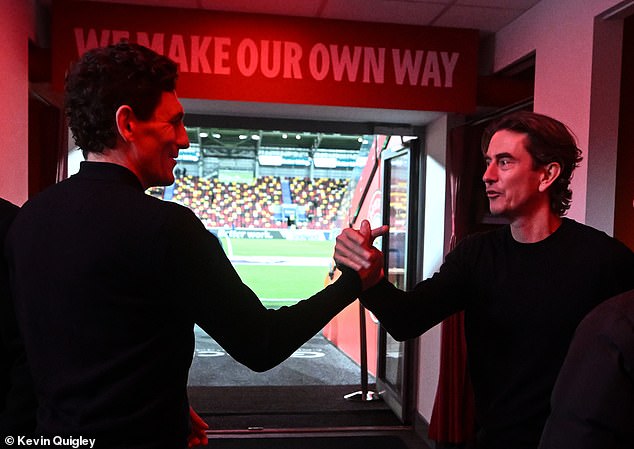
‘Just let me slide through here a moment, I’ll be right back,’ says Frank, as he pauses the pre-match interview he was doing with Tottenham’s in-house media team. Keith Andrews, chatting through an identical routine across the corridor, has the same idea.
‘Happy New Year,’ says Frank, greeting Andrews with one of those handshakes that becomes a hug. ‘Really good to see you.’
Frank’s return was always going to be one of the narratives. And by the end of the night, it will have shifted to the minutiae of a forgettable 0-0 draw and the booing from Spurs’ corner of the ground.
But we have been granted unprecedented access to see more than that. To see the wider workings of a Premier League club on a matchday. To see how it all comes together at a wonderful little stadium that is largely hidden from view beneath the M4 flyover.
Thomas Frank greets his former assistant Keith Andrews ahead of Brentford's clash with Spurs
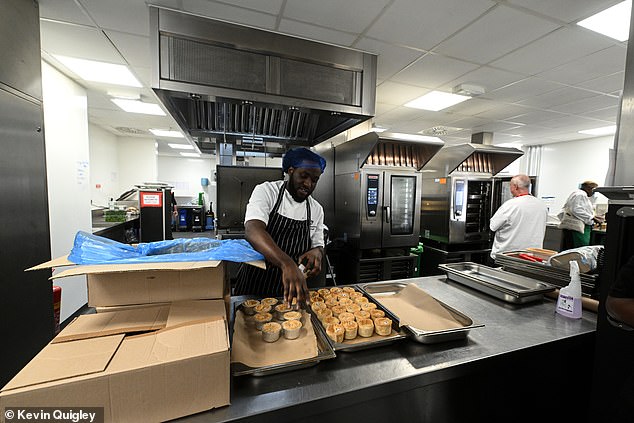
The kitchen staff - which is 300 strong - prepare 2,300 venison pies and 870 sausage rolls
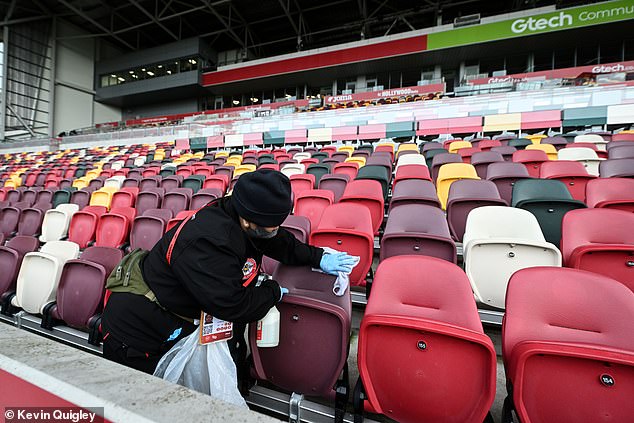
The Gtech is made up of multi-coloured seats because the stadium was built when the team were in the Championship (completed in 2020) and the design helps to mask emptier stands
Which is why, shortly before that hug, we noticed the head groundsman, Chris Cobbing, hovering by the pitch. Within a couple of hours, one half of his least-favoured scenarios would be carved into his masterpiece.
A few feet away is Ben Ryan, Brentford’s director of elite performance, who has just told us of his vision to one day build a Formula One-style pit wall at the training ground. It would serve as a hub for the data they love here: the kind to inform him that any winger who goes up against the Spurs left-back Djed Spence tends to experience higher workloads and might need subbing. He’s a smart fella in a smart club.
Out of sight is Bob Oteng, the kitman who goes back to the Griffin Park days of League One. We have also met caterers, security staff, community officers and the former policeman who runs stadium operations — he knows how to fix broken CCTV cameras on cold evenings. Same goes for busted water mains.
Frank’s return? To the 840-odd who work here on a matchday, that was only ever a tiny part of it.
We arrived at the ground at 1pm, seven hours before a calculated decision was taken to pressure Pedro Porro with a high ball from kick-off. As with most things here, there were reasons for it.
Likewise, the multi-coloured seats that stand out when this place is deserted. ‘Two reasons for that,’ says Dave Gregg, Brentford’s associate director of operations. ‘One is that when we built this stadium (completed in 2020) we were in the Championship — multi- coloured seats are good at hiding the empty bits. The other is that red seats perish quicker, so we didn’t want all red.’
Brentford have aged well. Under Frank, they went from mid-table of the Championship in 2018 to the Premier League, where they have stayed. With Andrews having been upgraded from set-piece coach upon Frank’s departure, they are seventh in the top flight despite the lowest spending on player wages.
Gregg pre-dates both of them, and indeed Matthew Benham, the owner whose eclectic background in physics, finance, statistical modelling and gambling has been at the core of Brentford’s great leap from League One in 11 years.
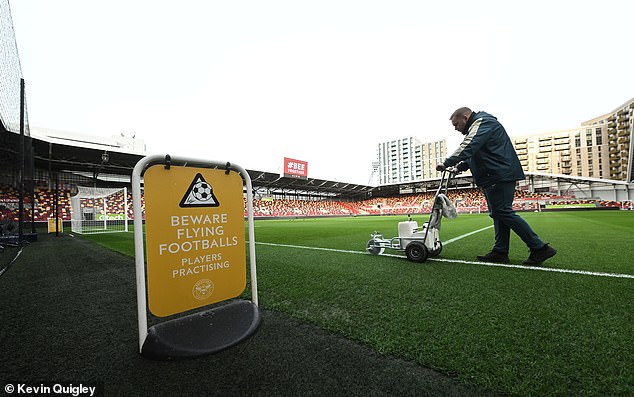
The pitch is tended to ahead of kick-off and the grass is cut to 21mm (27mm is the Premier League maximum) and the ground is set firm - allowing the ball to fizz around quicker
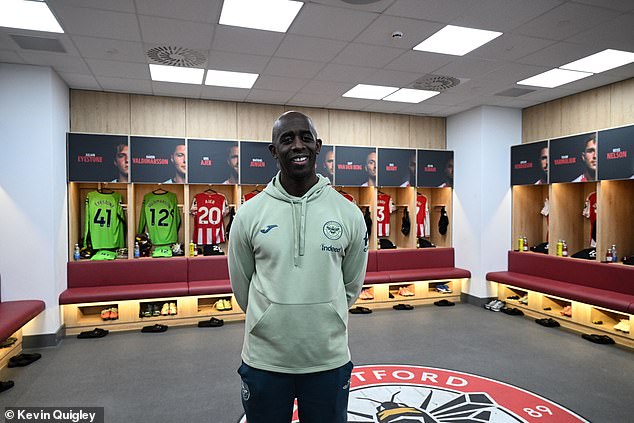
Head of kit operations, Bob Oteng, has been working at Brentford since their League One days
Gregg is one of those who would be considered part of the furniture at a club — he has been around Brentford since 2004, initially as the police match-day commander as part of his 30 years on the force and full-time since 2015.
Heading a team of 40, he tends to arrive eight hours before kick-off and is tasked with keeping little and large details in order. This is a straightforward day for him, barring a faulty CCTV camera on the south stand. ‘The cold can be a problem for the IT,’ he says.
At 5pm he will tell us it is fixed, which is a far more comfortable scenario than one that played out prior to this fixture in 2023. ‘We had a problem with the water mains and it went off 13 minutes before kick-off,’ he says. ‘We got sorted with 11 minutes to go but the kick-off was delayed.’ How long? ‘32 seconds.’
His memory for these things is exhaustive, which extends to telling us there have been only five items thrown on the pitch in this new stadium: two flares, a Werther’s Original, a vape and a wooden fork. It’s why the faulty camera mattered — Brentford have eyes on each of the 17,000 seats and take pride in the rarity of any kind of disorder. As they should. ‘Only 0.05 per cent of our visitors have required any kind of intervention,’ says Gregg.
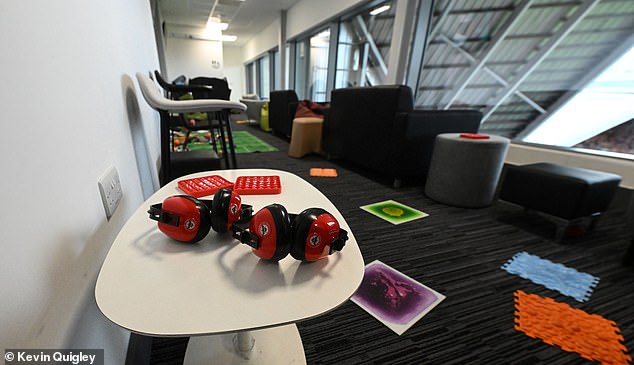
Various crowd surveys in recent years have listed Brentford as best-in-class. Only Bournemouth have a smaller capacity but few clubs do more in their community. One morsel of that is shown at 6pm, when a team of 10 are dispatched to the local Underground stations to assist disabled fans and a sound-proofed, pitch-facing room is opened for neuro-diverse fans. It’s a fabulous set-up.
‘When I started policing games at Chelsea in the Eighties, disabled access meant parking on the dog track by the pitch and watching from your car,’ says Gregg. While he is talking, 2,300 venison pies and 870 sausage rolls are being baked inside and distributed to 23 satellite kitchens.
Brentford’s head chef, Steven Robertson, got to work at 9am and is relieved that there has been no repeat of a previous New Year’s Day match, which had an early kick-off. ‘Mysteriously, we were left short-staffed the morning after New Year’s Eve,’ he says. There will be 300 here today as part of his unit, with the hour of peak stress commencing at 6.30pm.
It also transpires from a senior member of the catering crew that a sommelier was once enlisted to assist with the curation of Frank’s extensive wine collection.
Bees striker Igor Thiago's shinpads feature a tribute to his Brazilian roots and his family

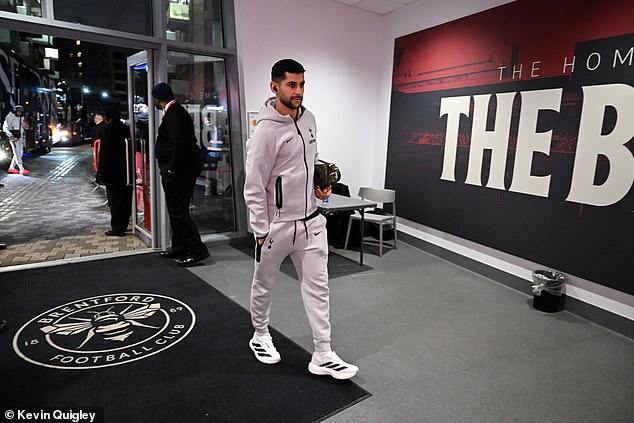
Tottenham's captain Cristian Romero arrives at the Gtech for the New Year's Day fixture
By contrast, the pitch lives in plain sight — four groundsmen have been applying the final touches through the morning and afternoon. Cobbing, their lead, has had the under-soil heating set to 12 degrees for the better part of a week to combat the chill, but will switch it off at 4pm.
‘If you don’t do that, you’ll see the vapour coming through the grass when the match is on,’ Cobbing says.
As it happens, there is a refined art to this. ‘Do you ever see yellowing patches on the pitches?’ Cobbing asks. ‘That’s what happens when they have left it on too long and cooked the roots.’
He has been here since 11am and will leave at 1am, with a plan already in place to crank up the heating to 16 degrees ahead of the Sunderland game on Wednesday, with a cold snap forecast. For this match, he has cut the grass to 21mm (27mm is the Premier League maximum) and the ground set firm. ‘That comes from talking to Ben Ryan about what kind of surface he wants — firm is for when we want it fast.’
Those are tactical considerations. Others go to preservation — the south stand catches less light and is harder to maintain. ‘Before each game we tell them which areas to avoid in the warm-ups and the Premier League can step in if a team overdo it,’ he adds. It’s all part of the tapestry, as are the futile wishes of ground staff.
‘The worst thing for me tonight is a Tottenham winner and then a long knee slide that cuts into the grass,’ Cobbing says. There will be no goals in this game but Micky van de Ven does leave an 8ft trail after launching into a sliding tackle in front of the south stand.
As the clock approaches 5.30pm, Ryan is describing the Brentford DNA. Ryan’s remit here travels to the heart of the front-of-shop operation. In a previous stage of his career, he was the coach who led Fiji to a rugby sevens gold medal at the 2016 Olympics. For the past four years, he has been a key part of the brain bank driving Brentford.
He got to work at 11am and will spend the game behind Andrews’s dug-out. The use of data has underpinned Brentford’s recruitment success in the Benham era and has increasingly influenced tactical calls on the pitch.
Brentford's Jordan Henderson heads through the tunnel to the changing room at half-time
The club uses GPS data in real time to feed observations to their sports science teams, helping Brentford to gain a better handle on injury prevention while a game is going on
‘We use data a huge amount in our recruitment model, obviously, but from a playing perspective in the last six to nine months we’ve really pushed on,’ says Ryan.
‘We’re very similar to everybody else in what data we capture, but it is then about how you use it, which we hope is where we’re a little bit better. The signals from the GPS units the players wear can give you pages of data for every second and if you’re not careful, you can get lost in that.’
Ryan depicts three stages in Brentford’s data chain: performance analysts, data analysts and sports scientists. On the touchline against Spurs, that manifests itself in a three-man line of communication that starts with Dr Ben Cousins, their head of performance planning. According to Ryan, he possesses a ‘special brain’.
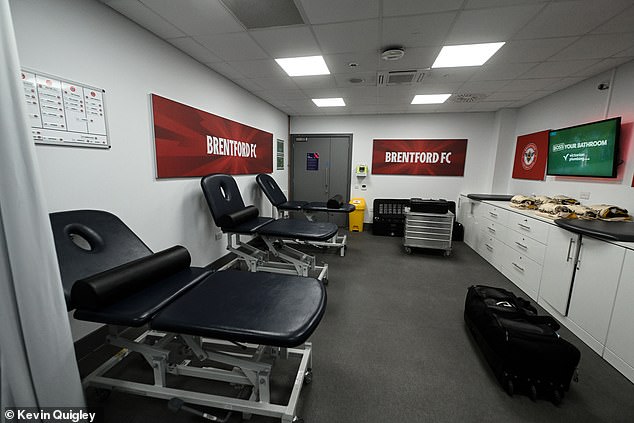
Cousins will take in the GPS data in real time and feed observations to Rob Rayner and Toby Banfield, who together lead the sports science teams. Combined, they can gain a better handle on injury prevention.
Where the metrics race appears to have growth potential is through the use of software that provides in-game running data on an opponent, so coaching staff can better predict if a rival is tiring and worth targeting. Ryan says: ‘It’s still rare that you get a real massive moment, like, “Double up against this kid, because he is way over his metrics, and he’s just not going to be able to cope with it”. But you do get them occasionally.
‘Normally, we might be looking at one of our players who we predicted might manage 75 minutes, but if he has been under-loaded we can relay to Keith that he might be OK for the 90.
‘Keith is always king on that stuff and we provide as much information as he needs. He is very clued up on it and it’s a big part of what we do to find an edge.’
Ryan envisions a time when Brentford might emulate a Formula One team, saying: ‘One idea we had was something like a pit-wall in a quiet room at the training ground with the screens. We went to Red Bull last year and it was absolutely fascinating.’
At 6pm a team open up a sound-proofed, pitch-facing room for neuro-diverse fans
Ben Ryan, Brentford's director of elite performance, one day wants to see a pit wall like those seen in Formula One installed into the training ground which they could use as a data hub

That might be a glimpse of football’s future and it’s all a light year removed from Brentford’s past.
Many of those here were part of it, including Oteng, their long-time kitman. He remembers Griffin Park when there was one toilet in the away dressing room. ‘Yeah, and it didn’t have a door,’ he says.
Today, he lists the midfielder Mathias Jensen as the neatest of a ‘respectful’ flock and that the procurement of socks with looser elastic is why Brentford have not kept to the modern trend of hand-cut holes into their backs.
A scan of the illuminated, personalised spaces in the dressing room shows Kristoffer Ajer has the tiniest, thinnest shinpads of the bunch. Nathan Collins has the biggest and most worn. ‘He’s kept them since he was 13,’ says Oteng. ‘The players all have their idiosyncrasies and details that you might not see.’
We might say the same for the wider circus of a matchday in the Premier League.