
'/%3e%3cdefs%3e%3clinearGradient%20id='prefix__paint0_linear_4737_37157'%20x1='3.018'%20y1='23.6'%20x2='44.925'%20y2='24.977'%20gradientUnits='userSpaceOnUse'%3e%3cstop%20stop-color='%231CB7FF'/%3e%3cstop%20offset='.502'%20stop-color='%232FF58B'/%3e%3c/linearGradient%3e%3c/defs%3e%3c/svg%3e)

Setting The Record Straight On Manchester United’s DNA
Jan 12 2026 19:16 · By onefootball.com · 19 Reads


Many people around Manchester United , whether that be pundits, fans or former players and legends, have come under criticism in recent months for referencing the term, Manchester United’s DNA . Some feel it’s a buzzword with little to no meaning. Can a club really have an ongoing DNA? And if so, how can one define that DNA in exact terminology?
Of course, the overall idea of United’s DNA is winning football matches. It’s winning football matches and winning league titles along the way. Success is the core ingredient of the football club from top to bottom, but it’s not just success for the sake of success. There’s a way of being successful. A school of thought employed at United that should come alongside that success. And it’s a school of thought that very few people who haven’t played for or been associated with the club in some way will be able to accurately quantify or understand.
The days of Wayne Rooney, Ji Sung Park and Cristiano Ronaldo darting through the dazzling lights at the Emirates Stadium are a memory that always captures the minds of Manchester United fans when reminiscing about the days when the United DNA was evident, but the formulation of this ideology was crafted countless years before that.
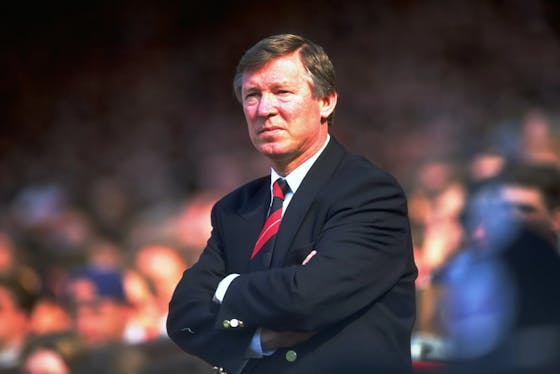
8 May 1994: Portrait of Manchester United Manager Alex Ferguson before an FA Carling Premiership match against Coventy City at Old Trafford in Manchester, England. The match ended in a 0-0 draw. Mandatory Credit: Shaun Botterill/Allsport
Before those three players, it was Duncan Edwards, Tommy Taylor, Eddie Colman and even Sir Bobby Charlton, and so many more.
Youth, Courage and Success is a core value at the club. It has been this way since the Busby Babes achieved what they did before the horrific events of the Munich air disaster under the guidance of one of the most important figures in the club’s history , Sir Matt Busby . In the year of the Munich disaster in the 1957/58 season, the average age of the players in the squad was 22. They were developed by Manchester United , and given the first team opportunity in the starting eleven and the squad to prove that with youth players correctly nurtured in the right environment, you can achieve anything in football.
This is why there has always been such a focus on the United Academy. Nick Cox , former Head of Manchester United’s Academy, has previously spoken about the fact that it’s an unbelievable thing that so many fans are invested in Manchester United’s younger sides being prepared for life at first team level within the walls of Carrington, and the Cliff before that. It’s a way of life, playing for United. Giving them lads a first-team chance is part of the DNA of the club. It’s not the same at Liverpool, Chelsea or Manchester City.
“I love how much interest there is in the Academy at Manchester United …people are so supportive of the work we do. There is no other club like it when it comes to youth development, ” Nick Cox speaking about the coverage of Manchester United’s youth academy.
These clubs may give academy debuts, but it doesn’t seem to mean as much as it does at United. Those clubs and fans may argue differently, of course, and if this is coming from an area of potential bias, then apologies are in order, but history does not lie. 257 academy graduates in the first team, with Bendito Mantato becoming the most recent after Jack Fletcher and Shea Lacey. Some of them 257, have turned into club legends, some of them have gone on to have successful careers elsewhere, and every one of them has contributed to the history of this famous football club.
The Busby Babes , the Class of 92 , also known as Fergie’s Fledglings . They’re all major parts of the identity of Manchester United , and that cannot be rewritten by those who don’t understand or want to educate themselves on what this means.
You could argue that there is no Manchester United of today without those teams. Without those risks, there would be no treble in 1999. Without those youngsters being given their chances, there’s no 13 Premier League titles. It’s vital that the next manager after Carrick understands these values and commits to keeping them going.
A record United have that no other club can come close to is the fact that they have had an academy graduate in the team in every match day squad since October 1937, which is a whopping 4,377 games without a squad that had an academy graduate from the club involved. It’s the proudest record a club could have.
Youth and the introduction of it, however, is not the only barometer of measurement for what the “UNITED DNA” truly is. It’s risk and chaos. It’s attacking football. Wing wizardry. Fast-paced, take your breath away as you stand up in your seat at the Theatre of Dreams type of stuff. Awe and satisfaction all rolled into one, creating that famous Old Trafford roar that has made the hairs stand up on millions and possibly billions of necks over the years.
That style was born long before Alex Ferguson. That way of playing and doing things at the club wasn’t only instilled when the legendary Scottish manager took over. He perfected it. Understood it was mandatory when he stepped into the football club and took it on board, and made a career winning trophies out of that mantra.
“When I see United attack, I want to see them attack with four things: pace, power, penetration and unpredictability.” , what Sir Alex Ferguson told Rene Meulensteen how he wanted his sides to play in 2007.
It’s taking a centre back off for a striker when you’re drawing 1-1 at home and don’t want to settle for a point. It’s making that 50-yard pass to try something new when a game goes stale. It’s hearing the humm craving “attack attack attack” in the 90th minute and pushing for the jugular to get the winner.
United scoring so many late goals under Fergie wasn’t an accidental occurrence; it was by design. It was a relentless surge of risk, cultivating in one of the most dangerous and undefendable teams this league has ever seen and will ever see again.
The Sir Bobby Charlton video has been referenced so much in recent days. “ Adventurous, exciting football, playing young players, entertaining the crowd “. This was said almost 30 years ago. It’s not just a buzzword for a punditry of fan topics that should be tossed aside. It means something. You can feel the difference in Manchester United when they are playing the United way or not. United under Solskjaer felt like a club the fans could get behind. It was different from the Louis Van Gaal era. Van Gaal adhered to the youth, courage and success policy, but the football he played was anything but that of a United side.