
'/%3e%3cdefs%3e%3clinearGradient%20id='prefix__paint0_linear_4737_37157'%20x1='3.018'%20y1='23.6'%20x2='44.925'%20y2='24.977'%20gradientUnits='userSpaceOnUse'%3e%3cstop%20stop-color='%231CB7FF'/%3e%3cstop%20offset='.502'%20stop-color='%232FF58B'/%3e%3c/linearGradient%3e%3c/defs%3e%3c/svg%3e)


Franco Baresi, the immaculate defender who defined a legendary era of Italian football
Jul 31 2026 16:49 · By onefootball.com · 11 Reads


Until Franco Baresi came along, Gianni Rivera was arguably the finest player in AC Milan’s history. Their careers briefly overlapped, when teenager and veteran respectively. A couple of decades later, Milan named their player of the 20th century. It was Baresi, not Rivera, a sign of the heights he had reached. Another, after Baresi’s passing at just 66, came from Rivera. “The greatest defender Italy has ever produced,” he said. Which, given the importance Italy has placed on defending, was saying something.
Another came in the tribute of a man who is often described in such terms. “The greatest player I ever had the honour of playing with,” said Paolo Maldini. He inherited the Milan armband from Baresi, took the club’s appearance record – an astonishing 902 games to top a remarkable 719 – but forever looked up to the man he called “nostro Capitano”.
The word occurred elsewhere. “CAPITANO,” wrote Fabio Cannavaro, in capital letters. He never played under Baresi and went one better than him by lifting the World Cup as captain. But Baresi’s influence meant Cannavaro looked up to him. “We young defenders all emulated you,” said the 2006 Ballon d’Or winner; Baresi, the 1989 runner-up, came closer than virtually anyone else to the kind of individual honour that normally eludes those who play at the back.
But there always recognition at San Siro and not merely because there was a four-year spell when Inter were captained by Giuseppe Baresi and Milan by his younger brother. “6 per sempre capitano,” read the headline on the Rossoneri’s tribute. Franco was skipper from his appointment at 22 to his retirement 15 years later; his No 6 shirt was retired with him.
There were six Serie A titles, three European Cups as well; two relegations in his early days, too, one due to a betting scandal, with Baresi showing the loyalty to stay. It was a reason why Jamie Carragher called him “the ultimate one-club man”.
Yet the greatest Italian defender, in Rivera’s estimation, also became a very unItalian defender; or one who, under Arrigo Sacchi’s revolutionary management, transformed Italian defending. Baresi began as a libero, a position Sacchi rendered redundant. He became a centre-back who mastered the offside trap in a formation that was an antidote to catenaccio.
open image in gallery
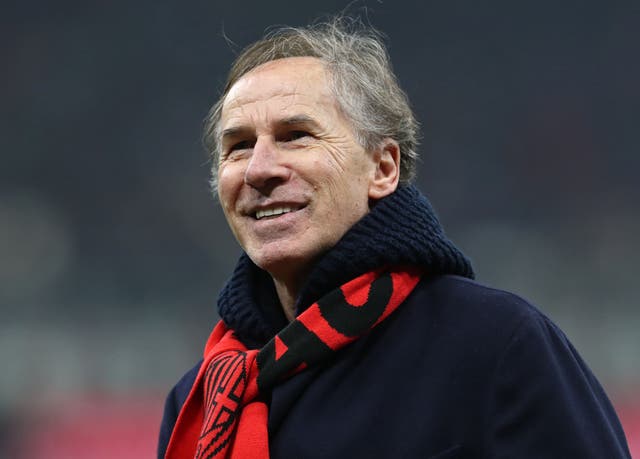
Baresi was arguably the greatest player in Milan’s history and captained them during their golden era (Getty)
Initially sceptical about the ideas of the former shoe salesman plucked from Serie B, Baresi became the personification of a different approach. “We played a new football for Italy: fast, aggressive, and organised,” Baresi recalled in 2019. It was a flat back four, pushing up to press, creating a compact 4-4-2 formation.
Baresi was the on-field organiser, sometimes silently. They moved in harmony with each other. “We could find each other with our eyes closed,” he said in 2021. And, almost three decades since they last played together, they remain perhaps the most famous back four of all: Mauro Tassotti, Alessandro Costacurta, Baresi and Maldini. Between the quartet, they played more than 2800 games for Milan.
One of the greatest of their era, the 1994 Champions League final demolition of Barcelona, came when both Baresi and Costacurta were suspended. But in winning the European Cup in both 1989 and 1990 – the former when hammering Real Madrid 5-0 in the semi-final and Steaua Bucharest 4-0 in the final – they were the last team to retain the trophy for 26 years.
It was a feat that gives them a case to be the greatest side ever. It was built on a redoubtable defence. When Serie A was indisputably the world’s strongest division, Milan conceded just 14 goals in Serie A in 1987-88, 19 in 1990-91, 15 in 1993-94.
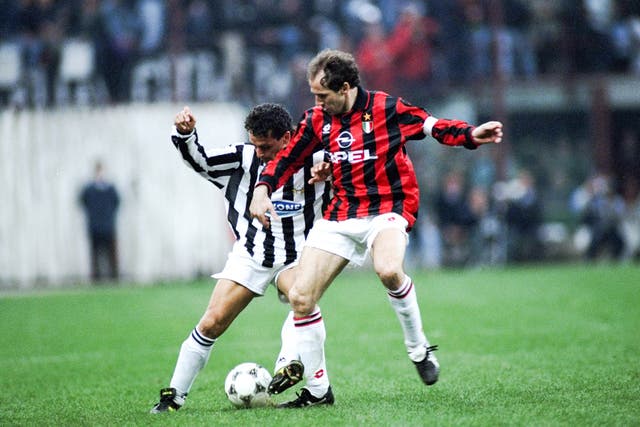
Baresi became the first player in Italian football history to have a shirt number retired after him (Getty)
At its heart was Baresi, with the enviable capacity to make everything look easy. He was a reminder that some of the best defenders can lack either height – in his case, at just 5ft 9in – or pace; they compensate by reading the game, which he did better than almost anyone else.
One of his most astounding performances came when 34 and injured, and yet ended horribly cruelly. Baresi had been a World Cup winner in a tournament when he did not play, in 1982. By 1994, he was Sacchi’s captain, but injured in the group game against Norway. He returned 25 days later, and 22 days after knee surgery, to subdue Romario, Bebeto and Brazil in the final; but in the shootout, Baresi’s penalty, like Roberto Baggio’s, was skied.
It was a rare misstep by a player who was often immaculate. Revered even by those who achieved greatness in their own right, he can seem part of a distant era, when Italy reached World Cup finals, rather than failing to qualify for the tournament, when Milan were the outstanding side in the world, not the side who finished fifth in Serie A. Milan can mourn their past, too, but the loss of Baresi also underlines how special he was.
Six years ago, on his 60th birthday, another candidate for the title of their player of the 20th century, and the man who denied him the Ballon d’Or, Marco van Basten said: “He led the Rossoneri backline in a great and elegant way. He was calm and shy, but on the pitch he was a warrior and a winner.” Van Basten called his old captain “the Johan Cruyff of defenders”. And if Cruyff changed football, so did Baresi.